2026.06.15
Designing Found's Quest Log
I currently have one playtester. Like me, he has too much going on. Unlike me, he will go weeks between sessions. And at the same time, I keep adding new things to the game between each playtest: characters, side quests, and other details that suddenly strike me as absolutely necessary. So my playtester comes back to Found after a few weeks away, and the world has grown with new people to talk to and places to explore and objectives to complete. With all of these new distractions (some actually new, some that he’d just forgotten), my playtester struggled to remember what he was trying to do the last time he played.
He wanted the game to provide an answer. I provided an alternative: write it down.
We went back and forth on this for months. Should Found have a quest log? On one hand, yes, obviously. Players need some way to track what they’re doing. This is not a radical design revelation. Games have been solving this problem for a long time.
On the other hand, Found is a game about memory.
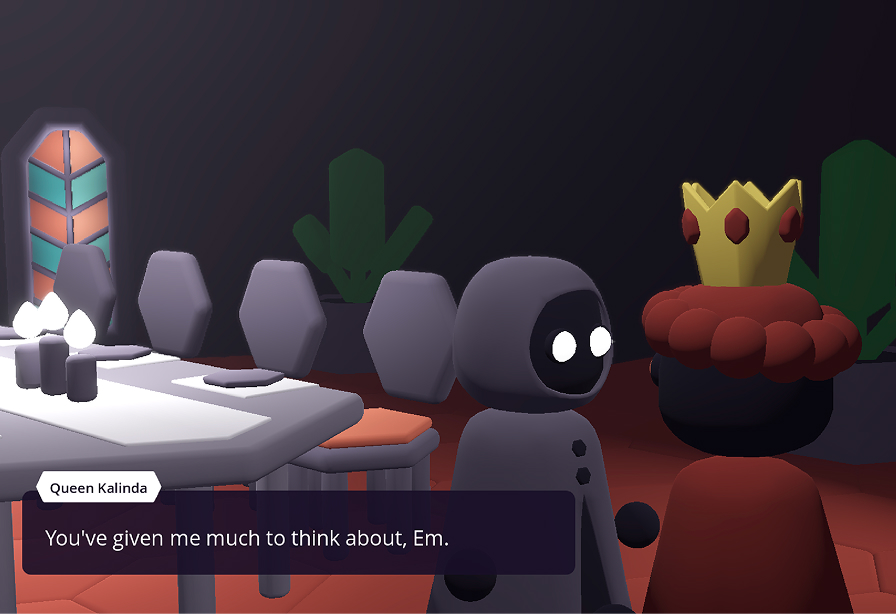
The world has broken apart. Em’s memories are scattered across it. A lot of the game is about recovering meaning from fragments, paying attention to small details, and slowly building a sense of what happened. Having a menu that clearly says “go here, do this, collect that” didn’t feel authentic. It was too explicit and efficient and productivity-oriented. Of course, as someone with an often photographic memory, it’s easy for me to declare memory aids aesthetically impure.
Eventually, though, the repeated struggle of my playtester and partner became hard to ignore.
For a released game, players can compensate for confusion in all kinds of ways. There might be a Reddit thread. A Discord server. A wiki. Someone obsessively building and sharing a spreadsheet. But in my house, it’s just me. And when the only person testing the game kept losing track of what he was doing, I couldn’t keep denying that something was missing.
So I started researching how other games handle quests. There was the straightforward approach: a clear list of objectives that updates after every meaningful interaction. Useful, comprehensive, and very easy to make too explicit. Zelda does this well, but it also tends to tell the player exactly what state the quest is in, where they should go, and what they should care about next. I considered something more journal-like, where notes would be added as Em experienced things. That felt closer to the tone of Found, but still a little too literal. I also thought about adding rumors – a list of loose threads, some of which would become quests and some of which might never resolve at all. I liked the ambiguity of that, but it created a different problem. If anything could be potentially meaningful, what really made a quest a quest?
In the end, I chose something straightforward in structure but (hopefully) more poetic in execution.
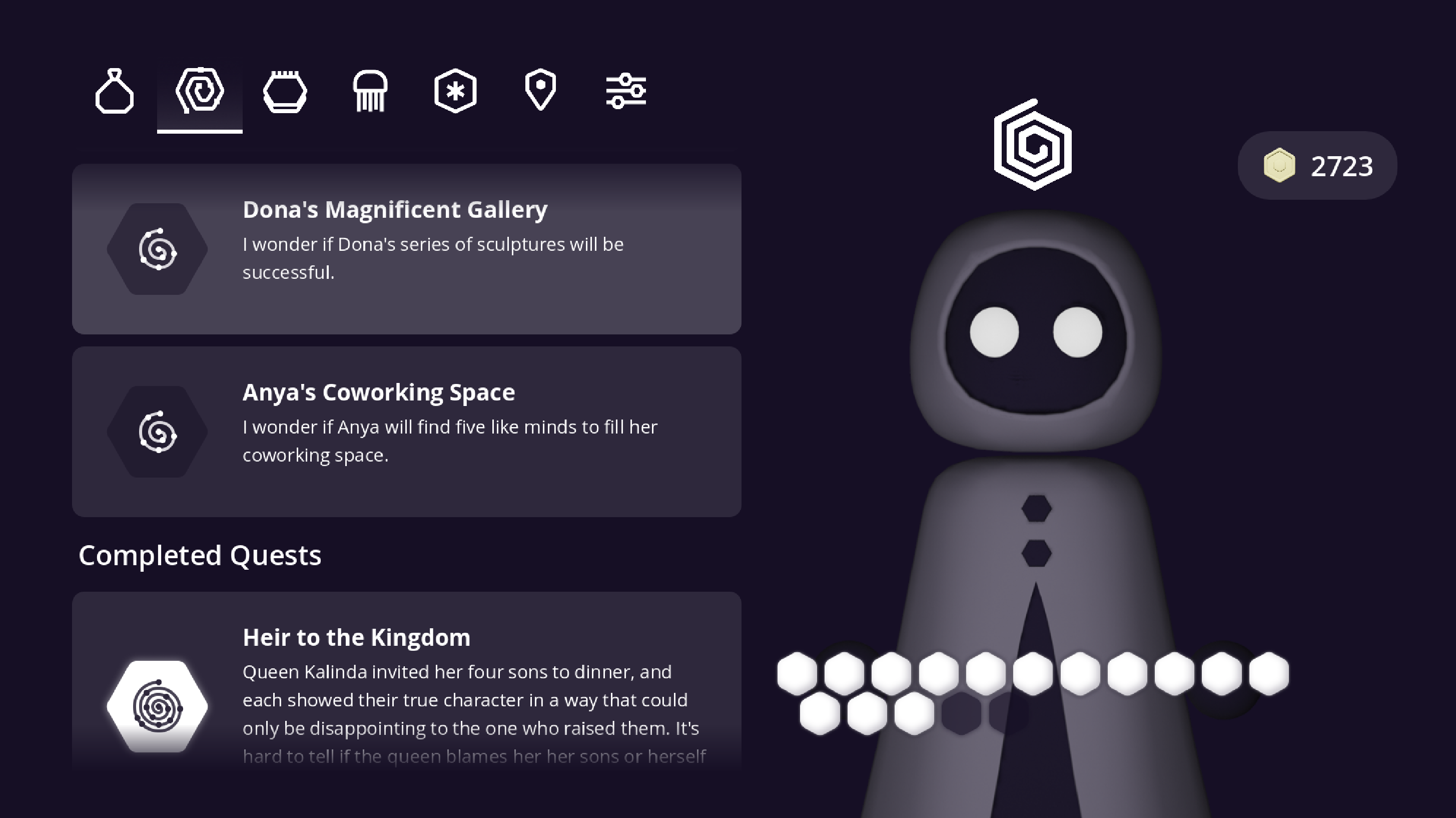
The quest log now lives in the inventory under its own tab. It’s a simple list showing in-progress and completed quests, with icons to distinguish main quests from side quests. Mechanically, it behaves the way a quest log needs to behave. It gives the player a place to return when they’ve forgotten what they were doing. But the writing doesn’t treat quests as instructions.
Open quests begin as curiosity: I wonder what Queen Kalinda has planned for her birthday. Surely it’s more than cake.
Once completed, that curiosity becomes an observation: Queen Kalinda invited her four sons to dinner, and each showed their true character in a way that could only be disappointing to the one who raised them. It’s hard to tell if the queen blames her sons or herself for what they’ve become.
The ambiguity, the tone, the shift in perspective – they’re all by design. The quest log is not just tracking completion. It tracks Em’s understanding of the world.
Another quest begins: I wonder if Fernin will ever figure out how to rise above it all.
Which later becomes: Fernin’s dream of rising above it all finally came true, but after dreaming for so long about something out of reach, will he stay satisfied for long? It seems like only a matter of time until he settles on a new ambition. For now, though, it’s nice to have a quick mode of transportation.
These capture the writing found throughout the rest of the game. Found can be strange and melancholy and full of broken things, but it is still a game. Sometimes the poetic resolution of a character’s longing is also a mechanic for speeding up travel. This became the core rule for the interface: quests should work as memory triggers, not directions. They should remind the player of the emotional shape of the thing they were doing, without flattening it into a checklist. They should preserve enough ambiguity that the player still has to re-enter the world, talk to people, look around, and remember through play.
The quest log exists because it’s easy to get distracted or to forget, but it tries to help players remember using the language of the game.